Radar is the sense the modern world runs on without noticing.
The current conversation about sensing is dominated by cameras, lidar, and the neural networks that process them. That is fair. Computer vision has become extraordinary. Yet the sensor that continues to underwrite air defense, civil aviation, weather forecasting, and increasingly the automotive industry is older, less photogenic, and in many ways far more capable. Radar rarely earns the headlines, for the same reason it earns its place on every consequential platform: it works when nothing else does.
What follows is a short overview of the technology, written for people who already suspect there is more to a blip on a screen than the screen lets on. The entirety of Top Gun: Maverick could serve as a few seconds of trailer for an honest radar movie, if anyone ever made one.
Why are we still talking about radar when cameras and AI keep stealing the spotlight?
Optical sensors collect photons. Radar generates the electromagnetic field it later receives back as a reflection. That single distinction explains most of what follows. A camera cannot resolve a target in rain, fog, dust, or at night without active illumination. A radar transmits its own waveform, listens for the reflection, and measures range, angle, and Doppler from first principles of electromagnetic propagation. There is no learned representation in the loop. The kinematic state of the target falls out of the math.
For applications where being wrong is not survivable, that determinism is the point. Radar can also tell you much more about the target itself. It can distinguish a mosquito from a house fly by their wingbeat signatures, or identify ice sheet layering and bedrock buried kilometers deep in Antarctica, which is exactly the kind of measurement a remote sensing center does, CReSIS for example.
What does a modern fighter aircraft actually see?
An Active Electronically Scanned Array, or AESA, replaces a single mechanically steered antenna with thousands of independent transmit and receive modules, each with its own phase and amplitude control. Beams are formed in software, steered electronically, and reconfigured within microseconds.
The practical consequence is that one radar can search, track, classify, jam, and host a datalink simultaneously, by interleaving these tasks across the pulse repetition interval. A pilot is not watching a sweep on a display. The pilot is consuming the output of an extremely fast scheduling problem solved in real time, where the radar decides how much energy to spend on which volume of sky based on what it already knows.
What happens in the last few hundred milliseconds before an interceptor finds its target?
This is where signal processing earns its budget. The seeker on a terminal phase interceptor is presented with a return that is a mixture of the intended target, decoys, fragments, atmospheric clutter, and either sea or ground returns depending on the engagement. The radar’s task is to keep the target track stable while the relative geometry changes faster than most computers can handle gracefully.
The mathematics involved is unglamorous and indispensable. Constant false alarm rate detection, range and Doppler ambiguity resolution, monopulse angle estimation, and several forms of clutter suppression all run inside the seeker, often on radiation hardened processors with strict latency budgets. The radar cross section of the target itself is a function of frequency, aspect angle, and polarization, none of which the seeker controls. The system has to be right anyway.
Who is watching when the weather closes in?
Air traffic control radars, ground based weather radars, and early warning systems are the parts of this story that most people never think about. The S-band primary surveillance radars at major airports continue to resolve aircraft in conditions that defeat every other sensor on the field. Long range early warning radars stare into space and provide the strategic timeline that makes deterrence numerically credible.
None of this is theatrical. It is the quiet condition that allows civilian aviation, ballistic stability between major powers, and severe weather warnings to function at all. When these systems work, nothing happens, which is exactly the point.
How did a defense grade technology end up in the family sedan?
The migration of radar into automotive platforms is one of the more interesting case studies in the commodification of defense electronics. Frequency modulated continuous wave radar at 77 GHz (ish), packaged as a few centimeter module behind a plastic bumper, now performs adaptive cruise, automatic emergency braking, blind spot monitoring, and lane change assist on vehicles that cost a small fraction of a single AESA module.
The physics is the same physics. The waveform is transmitted, the reflection is mixed with a local copy, and the resulting beat frequency yields range and range rate. Multiple input multiple output antenna configurations recover angular resolution that would once have required a much larger aperture. The integrated circuit packaging is where the engineering became economic.
There is a quiet public health story here that does not get told often enough. Adaptive cruise and automatic emergency braking, both fundamentally radar functions, have measurable effects on rear end collision rates. The sensor is not on the marketing material, but it is doing the work.
What does a radar engineer see that the rest of the world misses?
A target on a display is the end of a long chain of choices: waveform design, antenna pattern, sidelobe control, receiver dynamic range, sampling architecture, detection threshold, tracker association, and several layers of clutter rejection. Every one of those choices encodes assumptions about the environment, the target, and the threat. The discipline of building a radar is largely the discipline of being honest about those assumptions and quantifying what happens when they are violated.
That is the part of the field worth showing students. The dot (or classification) on the screen is the result. The interesting work is everything that decided where the dot would appear, with what confidence, and what to do about it. Radar does not advertise itself, conferences notwithstanding. That suits a sensor whose job is to be reliable rather than visible.
There is a quiet elephant in this room: stealth (mono/multistatic or RAM). Another article on that one, soon.
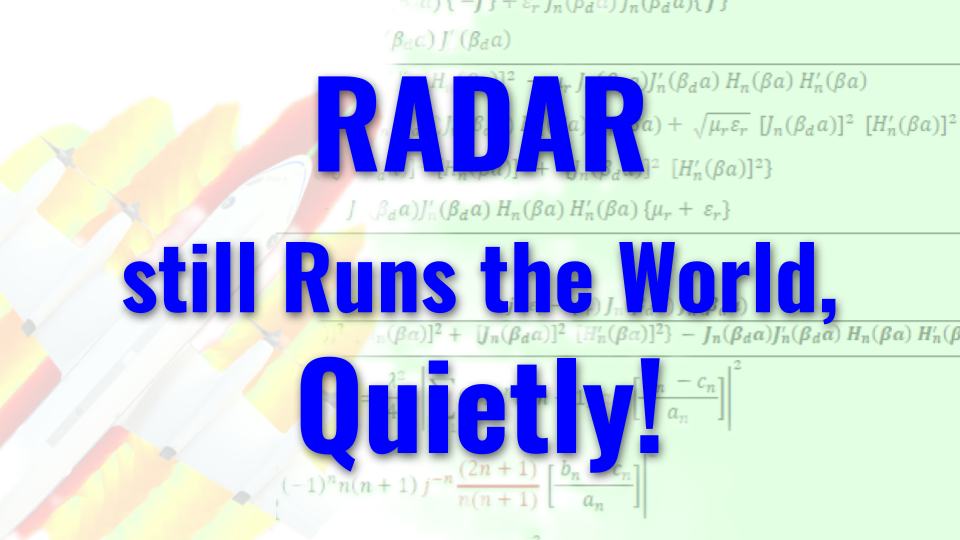
Background of the title image - Nadir sounding antenna array pattern from my NASA P-3 deployment, with a fragment of the monostatic RCS derivation for a dielectric object.
#Radar #RadarSchool #SignalProcessing #Electromagnetics #RFEngineering #AESA #PhasedArray #FMCW #MIMO #Stealth #DefenseTech #Avionics #Aerospace #Missile #Weather #AutomotiveRadar #ADAS #Drone #CUAS #Fighter #Interceptor